
What Probate Covers in Martin County
North Carolina probate is handled by the Clerk of Superior Court. Martin County does not have a separate probate court, surrogate court, or county probate judge. Estate filings route through the Martin County Clerk of Superior Court at the Martin County Governmental Center, 305 E Main St, Williamston, NC 27892. The court phone number is (252) 809-5100, and the mailing address for court purposes is PO Box 807, Williamston, NC 27892. The official courthouse hours in the research file are Monday through Friday, 8:00 AM to 5:00 PM.
Estate administration covers a deceased person's probate assets and debts. The North Carolina Judicial Branch estates guidance says the clerk appoints a personal representative to collect assets, give creditor notice, pay valid debts, and distribute property. Martin County probate records may include wills submitted for probate, applications, letters testamentary or letters of administration, small estate affidavits, preliminary inventories, creditor notices, accountings, orders, summary administration papers, and estate closing documents.
Estates Division of the Clerk of Superior Court
Martin County Governmental Center
305 E Main St
Williamston, NC 27892
Mailing: PO Box 807, Williamston, NC 27892
(252) 809-5100
Monday-Friday, 8:00 AM-5:00 PM
The state estates help topic is shown in the source image from North Carolina Judicial Branch estates guidance.
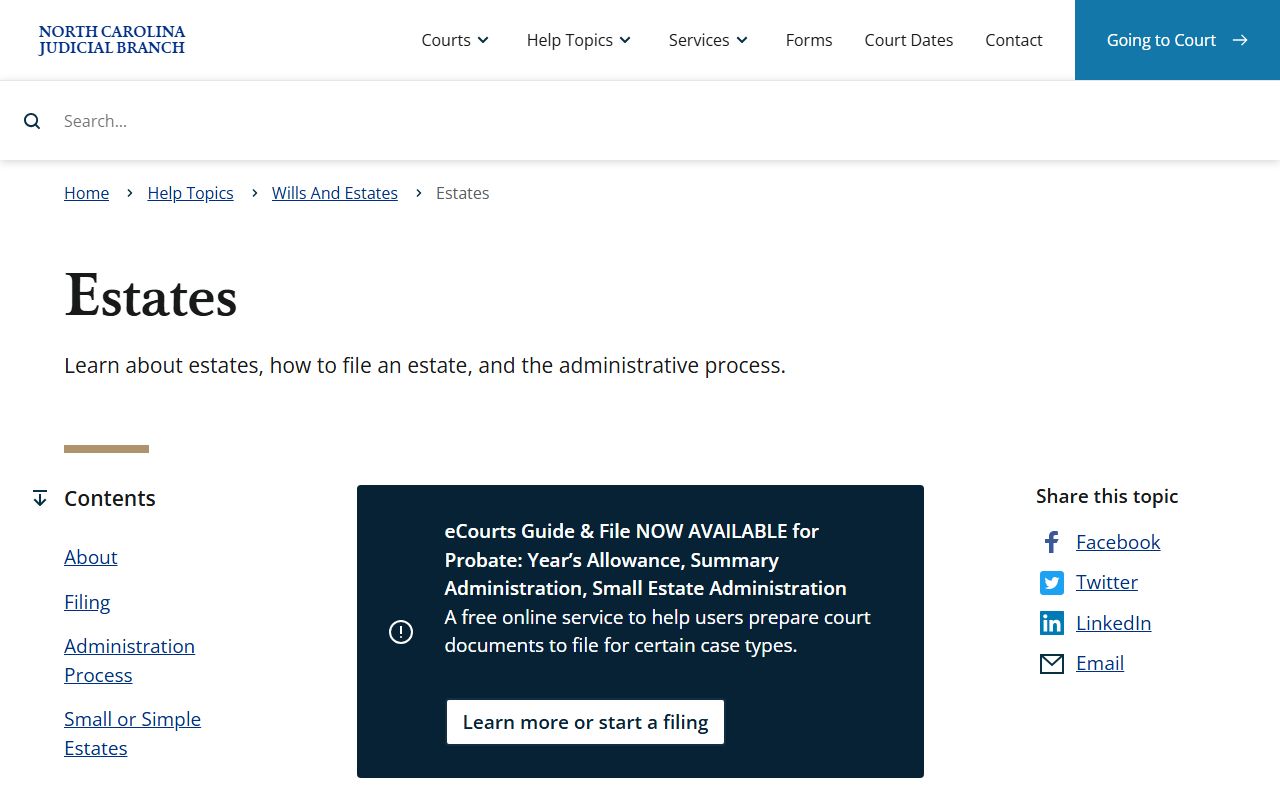
That state guidance is the main researched source for how Martin County estate administration is organized through the clerk.
Martin County Probate Terms
Estate records use terms that are easy to mix up. The definitions below use the North Carolina probate context reflected in the research file, with terms tied to the kinds of filings that may appear in Martin County probate records.
- Testator
- The person who made a will before death.
- Executor
- The personal representative named in a will and qualified by the clerk to act for the estate.
- Administrator
- A personal representative appointed when there is no will or no named executor able to serve.
- Intestate
- Dying without a valid will, which means distribution follows North Carolina law rather than written directions in a will.
- Letters
- Clerk-issued authority, such as letters testamentary or letters of administration, showing who may act for the estate.
- Small estate
- A simplified path that may use an Affidavit for Collection of Personal Property when the estate qualifies.
Probate assets may include vehicles, bank accounts, stocks, bonds, furniture, jewelry, and other property titled only in the decedent's name. Non-probate assets may include survivorship property, named-beneficiary life insurance, retirement accounts, joint accounts, and annuities. Land and houses generally are not administered through probate unless a will directs that result or a sale is needed to pay debts.
How to Search Martin County Estates Division of the Clerk of Superior Court
Probate search channels in Martin County start with statewide court systems, then move to local clerk access when the online record is incomplete. The North Carolina eCourts Portal may show estate or probate case information where available. The clerk's public self-service terminals can be used for civil, special proceeding, and estate case information. Paper files, certified copies, older wills, and complete estate packets are handled through the Martin County Clerk of Superior Court.
- Search the eCourts Portal for the estate name, decedent name, party name, or case number if known. Use Martin County as the location filter when the portal offers a location option.
- If the online case summary does not show the needed filing, use the public self-service terminal at the clerk's office or call the Clerk of Superior Court before traveling.
- For a will, letters, inventory, accounting, or certified copy, request the specific estate document from the Martin County Clerk of Superior Court.
- For older or paper-only estate files, plan for an in-person file review or ask the clerk what copy request details and fees are required by mail.
The public records statute source image from N.C. Gen. Stat. section 132-1 shows the broad public-record framework that applies unless a specific confidentiality rule limits access.
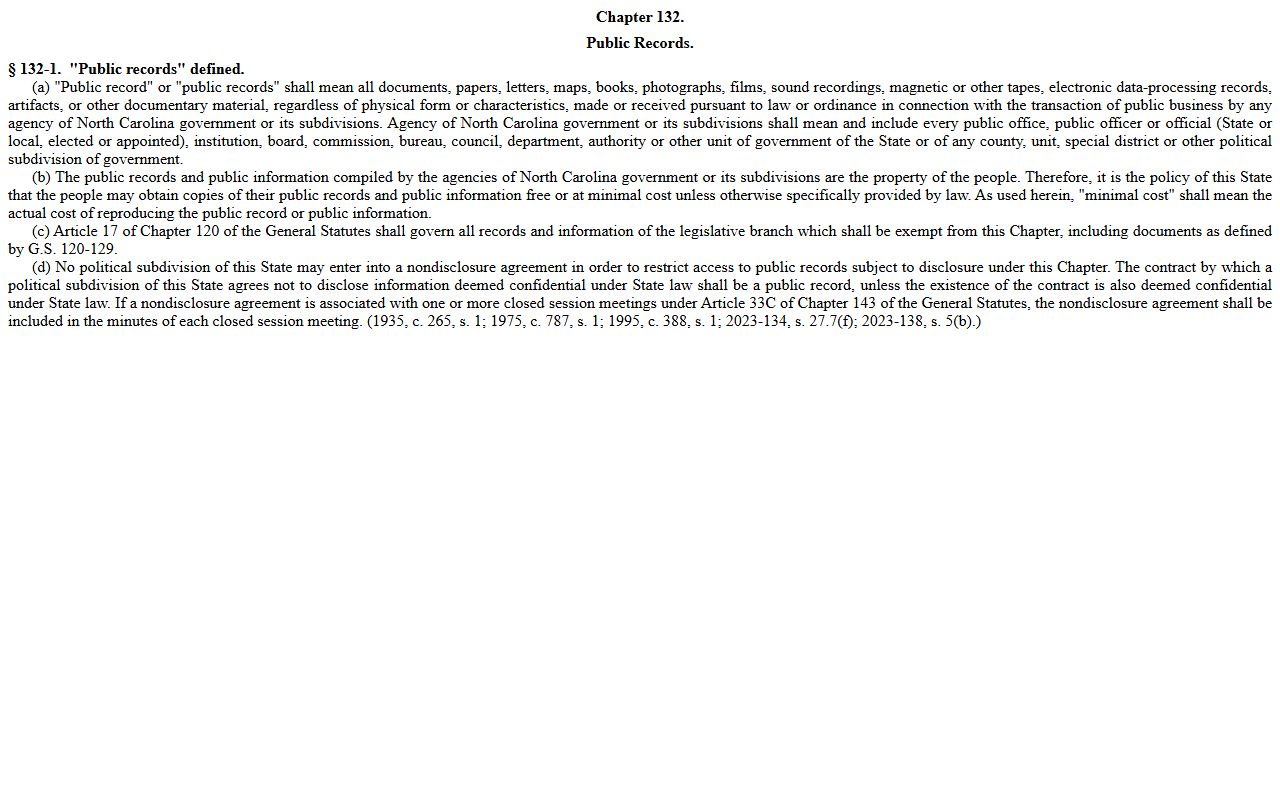
For court files, the more specific clerk recordkeeping rule also matters because court records are maintained through the Clerk of Superior Court.
Note: A portal result is not the same as a certified probate copy from the clerk's paper or electronic estate file.
Martin County Estate Forms
The North Carolina Judicial Branch estate forms search is the researched source for AOC estate forms. Martin County estate filers may need forms such as Application for Probate without Qualification of Personal Representative, Application for Probate and Letters Testamentary or Administration CTA, Application for Letters of Administration, Affidavit for Collection of Personal Property, Affidavit of Notice to Creditors, Oath or Affirmation, Letters, Inventory, Summary Administration petitions, and Estate Action Cover Sheet.
| Field Label | Type | Required | Options or Notes |
|---|---|---|---|
| Contains | Text | Optional | Keyword search for form title or subject matter. |
| Form Number | Text | Optional | Search by AOC form number, such as AOC-E-203B or AOC-E-505. |
| General Statute | Text | Optional | Search by North Carolina statute when known. |
| Subject | Dropdown | Optional | Includes Estate, Administrative and Accounting, Civil, Criminal, Juvenile, Small Claims, and Special Proceedings. |
| Language | Dropdown | Optional | Any, English, Espanol, and Tieng Viet are listed in the research field table. |
The estate forms search is shown in the source image from the North Carolina Judicial Branch estate forms page.
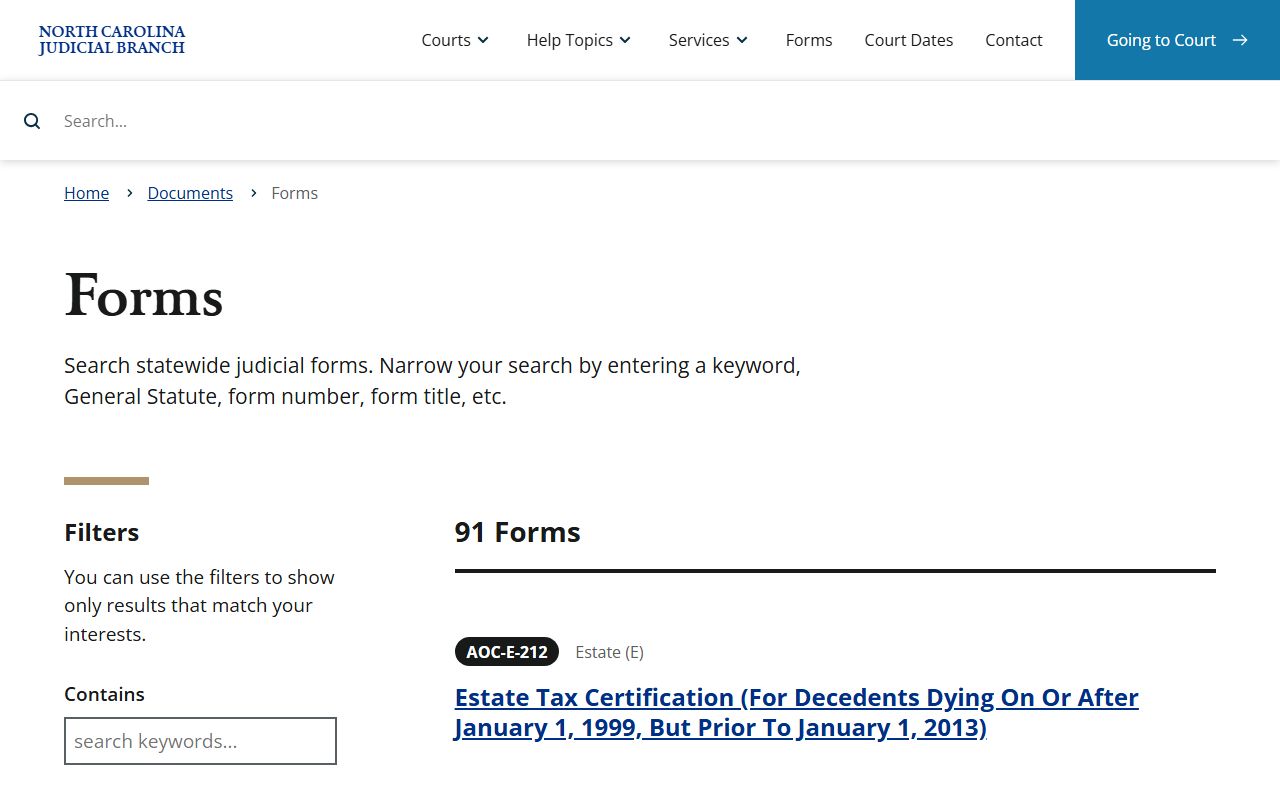
Form selection should match the estate facts, so uncertain filers should confirm the correct AOC form set with the Martin County clerk.
Martin County Probate Copy Fees
No Martin-specific probate fee sheet or local estate appointment fee schedule was found in the research. The safest researched fee source is the statewide current court costs chart and the clerk's office. The table below therefore uses researched statewide copy and certification charges that commonly affect estate record requests, not invented local estate filing totals.
| Item | Amount |
|---|---|
| Preparation of copies, first page of each document | $2.00 |
| Each additional page or fraction | $0.25 |
| Certificate under seal | $3.00 |
| Exemplification of records | $10.00 |
| Recording or docketing document, first page | $6.00 |
| Recording or docketing each additional page | $0.25 |
The current court costs source image from North Carolina current court costs points users to the official statewide publication.
Estate opening costs and any matter-specific probate fees should be confirmed with the clerk before filing because the research did not locate a Martin County probate fee sheet.
What Martin County Probate Records Show
Martin County probate records may show the decedent's name, date of death, county of residence, whether a will was filed, the proposed personal representative, heirs or devisees, creditor notices, asset categories, accountings, disbursements, and closing activity. A will filed for probate may identify beneficiaries and the person nominated as executor. Letters show who has authority to act. Inventories and accountings show estate assets, claims, costs, distributions, and the representative's handling of the estate.
Small estates and summary administration follow different paperwork. Smaller estates may use an Affidavit for Collection of Personal Property. Summary administration may be available when the surviving spouse is the sole heir or devisee. Estates may be reopened when newly discovered property or other statutory circumstances exist. North Carolina Guide & File has probate options for Year's Allowance, Summary Administration, and Small Estate Administration, but it prepares documents rather than replacing filing with the clerk.
- Determine whether a Martin County estate must be opened with the Clerk of Superior Court.
- Gather the death certificate, will if any, asset and debt information, and proposed personal representative information.
- Use the appropriate AOC estate form or Guide & File path.
- File with the Martin County Clerk of Superior Court and pay required costs unless waived.
- After appointment, give creditor notice, collect probate assets, file inventories and accountings, pay valid claims, and distribute property.
Restricted Martin County Probate Records
Most estate files are public court records unless a specific law or order restricts access. North Carolina public records law defines public records broadly, and N.C. Gen. Stat. section 7A-109 requires clerks to maintain court records, files, dockets, and indexes for public inspection during regular office hours except where law prohibits access. At the same time, some filings may contain protected personal identifiers, financial account details, addresses, medical information, or information involving minors.
Guardianship, mental health, adoption, juvenile, and sensitive family materials should not be assumed to be open just because they touch a probate or estate question. Redactions may hide Social Security numbers, financial account numbers, protected addresses, minor information, and other identifiers. If a requested Martin County probate record is sealed, confidential, too old for online access, or only partly visible in Portal, the next step is to ask the Clerk of Superior Court what access rule controls that specific file.
Note: The research found a local probate fee gap, not a local probate access ban, so the clerk remains the final source for exact file availability.