
Martin County Criminal Court Records
A Martin County criminal court record is the court-maintained file for a criminal case. It is different from the sheriff's booking record, a jail custody lookup, or an arrest report. The court record begins when a criminal charge, citation, warrant, magistrate order, indictment, information, or other charging paper reaches the court system. From that point, the Clerk of Superior Court maintains the case file, docket, indexes, and public access channels unless a law makes the record confidential.
Martin County is in North Carolina's unified court system. Superior Court handles felony criminal cases, jury trials in felony matters, and appeals from District Court misdemeanors and infractions for trial de novo. District Court handles misdemeanors, infractions, traffic-related criminal matters, and many first court settings. Magistrates play an early role through warrants, magistrate orders, initial appearances, and bond or release conditions. The charge detail itself is addressed more closely in Martin County arrest records and court charges, while broad case searching is covered through the main court records page.
Search Martin County Criminal Cases
The main online path is the North Carolina eCourts Portal. Smart Search can locate case information by record number or name, and Search Hearings can locate criminal court dates by location, hearing type, case number, party, attorney, judicial officer, or courtroom. For Martin County criminal court records, use the county location filter and avoid over-filtering at first. A misspelled name, wrong date, or too-narrow status filter can hide the correct case.
- Open Portal and choose Smart Search for a criminal case summary or Search Hearings for a court date.
- Select Martin County in the location filter before searching.
- Search by exact case number if available, or use the defendant's name in Last, First format.
- Review the case summary, docket events, hearings, disposition, financial details, and public document references.
- Contact the Martin County Clerk of Superior Court for certified copies, older paper files, background-check use, or records not visible online.
Public self-service terminals in clerk offices are another official channel. The Judicial Branch states criminal case information can be searched at terminals in clerk offices by defendant name, case number, or victim and witness name. The paper file itself is viewed in the county where the case is located. For a Martin County criminal case, that means the Clerk of Superior Court in Williamston.
Martin County Criminal Case Flow
Criminal case records develop in stages. Not every stage appears in every case. A citation may resolve by waiver or District Court disposition. A misdemeanor may involve an initial appearance, plea, trial, or appeal to Superior Court. A felony may involve district-level first settings, indictment or other superior-court charging action, pretrial motions, plea, trial, verdict, judgment, and sentencing. Each step can leave a docket event or filed document.
Case flow: Charges Filed › Arraignment › Pretrial or Motions › Plea or Trial › Disposition › Sentencing
| Stage | What Happens |
|---|---|
| Charges Filed | A citation, warrant, magistrate order, indictment, information, or other charging document opens the criminal track. |
| Arraignment or First Setting | The court addresses the charge, rights, counsel, plea posture, and future calendar needs. |
| Pretrial or Motions | Parties may file requests about evidence, discovery, suppression, bond, continuances, or other case issues. |
| Plea or Trial | The case may resolve by plea, bench trial, jury trial, dismissal, or other disposition. |
| Disposition | The court records the outcome for the charge or case, such as guilty, not guilty, dismissed, or other result. |
| Sentencing | After conviction, the judgment may state punishment, probation, costs, restitution, and other terms. |
What Martin County Criminal Records Show
A criminal court record is more than a list of charges. Portal training materials say a case summary may include case information, assignment information, party information, causes of action, case events, dispositions, hearings, and financial information when applicable. In a Martin County criminal court record, the view can include the defendant, case number, court location, filing date, case type, case status, charge data, attorney entries, hearing dates, docket events, disposition, sentence, and financial obligations.
| Field | What It Shows |
|---|---|
| Case Number | The court's criminal case identifier, sometimes using CR formats shown in Portal examples. |
| Defendant | The person charged in the criminal court case. |
| Charge | The formal accusation, offense description, count, statute reference, or charge class when visible. |
| Court Location | The county and court level tied to the case, including Martin County when filtered correctly. |
| Attorney or Counsel | Defense counsel, public defender appointment, or attorney information when available. |
| Hearings | Scheduled and past hearing information, including hearing type and sometimes judicial officer or courtroom. |
| Docket Events | Filings, motions, continuances, orders, pleas, judgments, and other register-of-actions entries. |
| Disposition | The outcome of the charge or case, such as guilty, dismissed, not guilty, or other result. |
| Sentence | Judgment terms after conviction, such as probation, active sentence, costs, restitution, or conditions. |
| Redactions | Information withheld because of juvenile law, sealing, expunction, or protected identifiers. |
Martin County Criminal Court Offices
Several offices touch criminal cases, but they do not all keep the same record. The Clerk of Superior Court maintains the court file and public terminals. Magistrates handle early criminal process and initial appearances. The District Attorney prosecutes criminal cases for Prosecutorial District 2, including Martin County. North Carolina Indigent Defense Services places Martin County in Defender District 2, with the public defender office in Washington for appointed representation. Sheriff or police records may document an arrest or investigation, but the filed criminal case record belongs to the court.
| Office | Role in Criminal Court Records | Contact From Research |
|---|---|---|
| Clerk of Superior Court | Court files, terminals, copies, criminal case records | 305 E Main St, Williamston; (252) 809-5100 |
| Magistrates | Initial appearances, bonds, warrants, magistrate orders | 305 E Main St; (252) 809-5119 |
| District Attorney | Prosecution, plea negotiations, victim consultation, criminal calendars | Local office: (252) 809-5110; district office: (252) 940-4010 |
| Public Defender | Appointed defense in criminal and juvenile delinquency cases | 227 N. Respess St, Washington; (252) 940-4014 |
The NC IDS Martin County source below is assigned to this criminal court records page.
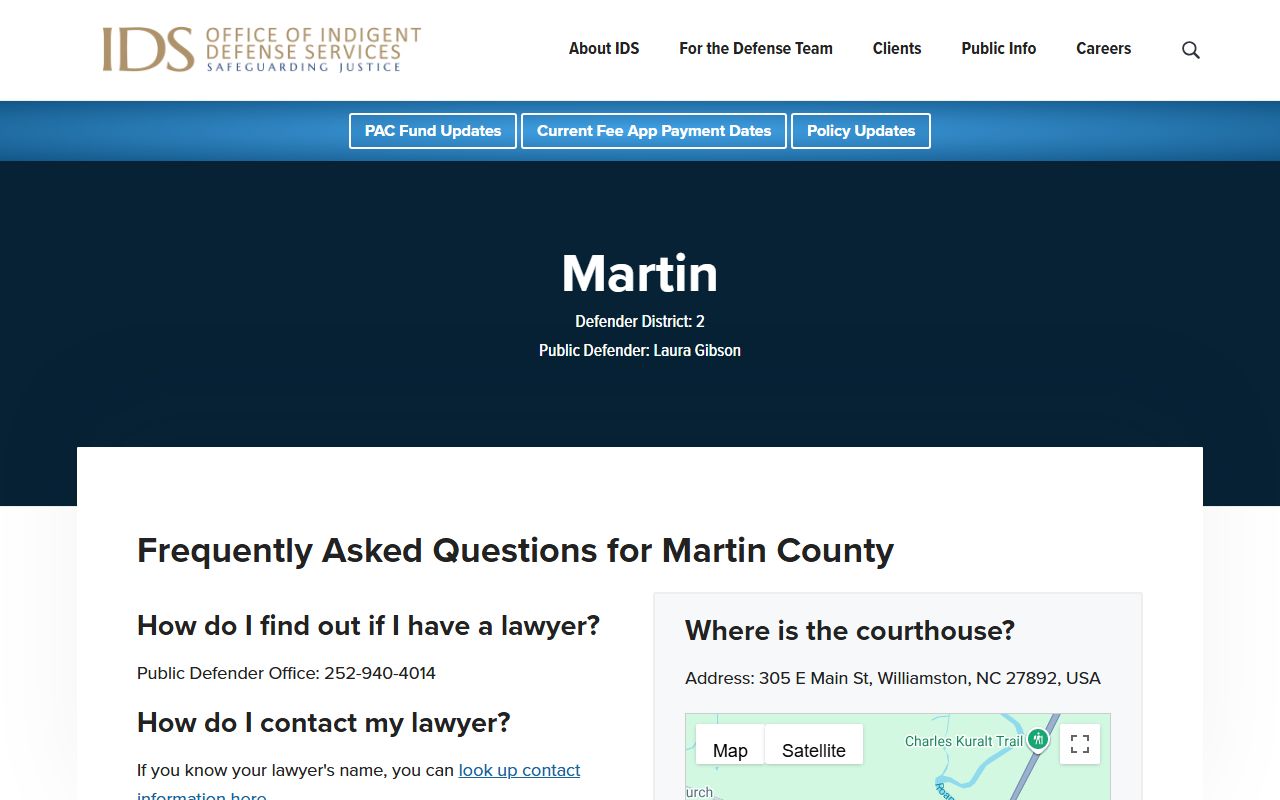
That source supports the distinction between court-file access and appointed criminal defense services in Defender District 2.
Martin County Charges vs Convictions
A charge is an accusation. A conviction is an outcome. Martin County criminal court records can show charges that were later amended, reduced, dismissed, deferred, or resolved with a not-guilty result. The public record may also show a conviction after a guilty plea, bench trial, or jury verdict. Reading the disposition field is essential because a charge line by itself does not prove guilt.
| Point | Charge | Conviction |
|---|---|---|
| Meaning | A formal accusation that a law was violated. | A guilty finding or guilty plea accepted by the court. |
| Where it appears | Charging document, docket, case summary, or count listing. | Disposition, judgment, sentence, and sometimes financial obligations. |
| Legal effect | Starts or narrows the criminal case but does not establish guilt. | Can lead to sentence, probation, costs, restitution, and collateral consequences. |
| Record risk | May remain visible unless dismissed, sealed, expunged, or otherwise restricted by law. | May remain visible unless eligible for expunction or other legal relief. |
Martin County Dispositions and Diversion
Disposition is the outcome of a criminal charge or case. Common plain-language outcomes include guilty, not guilty, dismissed, or other court action. Sentencing is separate from disposition. A conviction may lead to active punishment, probation, costs, restitution, or conditions. Some entries may be tied to a plea agreement, deferred process, appeal, or post-judgment event. The docket should be read with the judgment or written order when the legal effect matters.
Martin County is also part of District 2, where the Judicial Branch announced the Holistic Hope Mental Health Diversion Program on May 16, 2024. The program serves Beaufort, Hyde, Martin, Tyrrell, and Washington counties and is described for nonviolent offenders with a diagnosed mental illness connected to the offense. The district attorney reviews eligibility and consults victims. Diversion can affect how a criminal case moves and how the final disposition reads, but the research did not locate a separate Martin-only specialty court page.
Martin County Sealed vs Expunged
Restricted records require careful reading. A sealed record is not open to ordinary public inspection. An expunged record is treated under North Carolina law as removed, sealed, or destroyed as provided by the expunction order and statute. Juvenile delinquency, undisciplined, abuse, neglect, dependency, adoption, mental health, and protected personal information are also not ordinary public records. Portal may withhold confidential case types and protected identifying information from public view.
| Point | Sealed | Expunged |
|---|---|---|
| Public visibility | Hidden from ordinary public inspection. | Cleared from public record checks as provided by statute and order. |
| Record status | The record may still exist but access is restricted. | Court and law-enforcement records are removed, sealed, or destroyed as ordered. |
| North Carolina source | Depends on the sealing law or court order. | Chapter 15A, Article 5 and statutes such as 15A-145.5, 15A-151, and 15A-153. |
| Access path | Usually requires statutory authority or a court order. | Public access is blocked after a granted expunction, subject to legal exceptions. |
Martin County Expunction Records
For Martin County criminal charges or convictions, an expunction petition is filed with the Clerk of Superior Court in the county where the charge or conviction occurred. North Carolina materials say processing may take several months and generally list a filing fee, with exceptions for some dismissed or not-guilty matters and indigency. Certain nonviolent misdemeanor or felony convictions under N.C. Gen. Stat. 15A-145.5 require eligibility review, waiting periods, criminal-history limits, good-character conditions, and no pending warrant or case bars.
The nonviolent expunction statutory source below is one of the assigned criminal court records images.
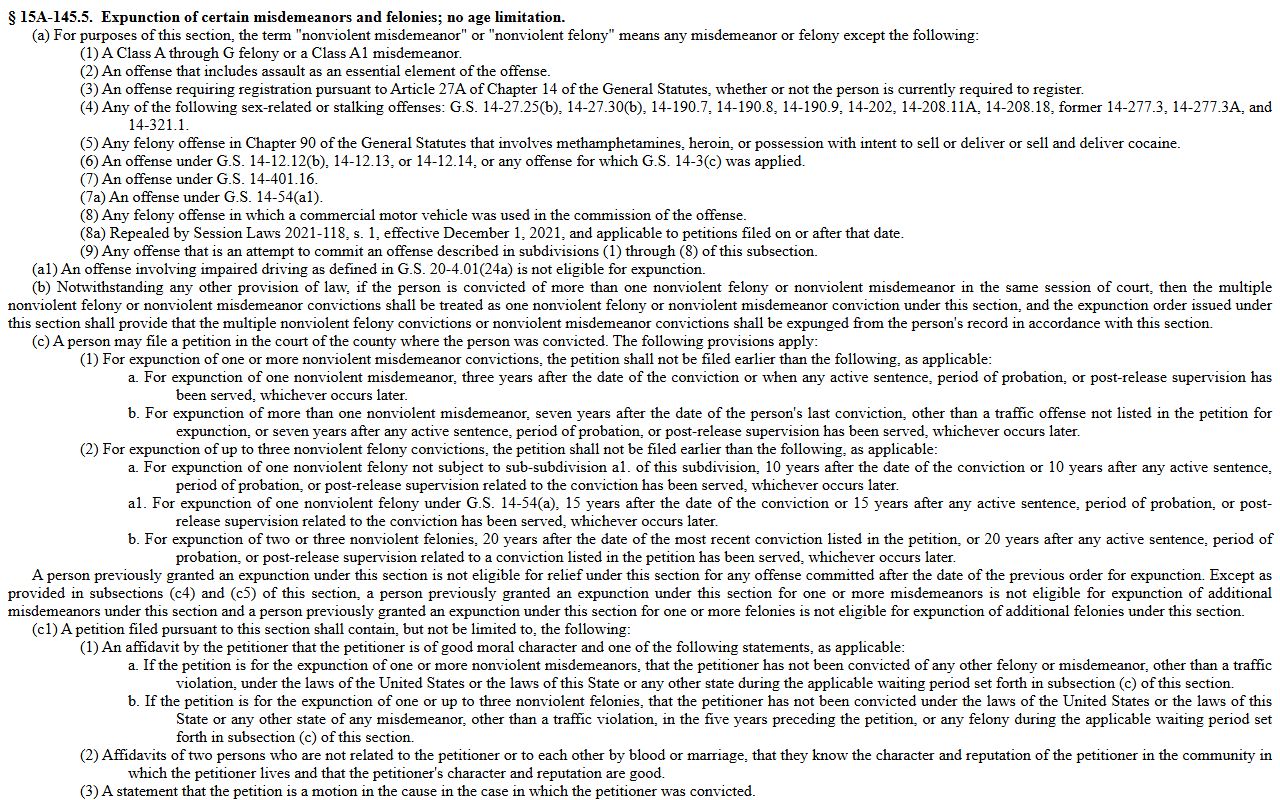
That statute supports the Martin County criminal records distinction between eligible expunction relief and ordinary public case access.
Chapter 15A, Article 5 is the broader expunction source for Martin County criminal court records when expunction is requested.
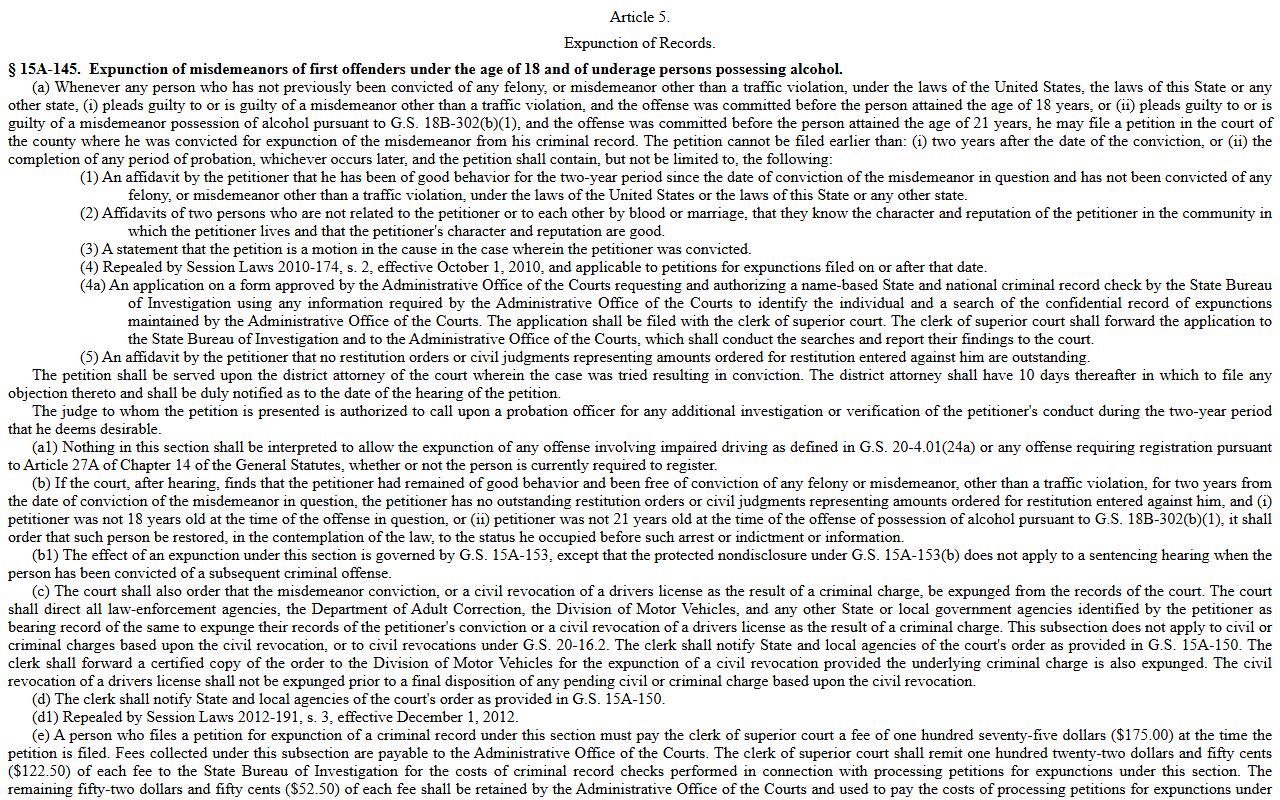
Expunction questions should be handled through the clerk and court process, not through a public Portal search alone.
Public Access to Martin County Criminal Records
North Carolina law makes many court records open but carves out major exceptions. N.C. Gen. Stat. 7A-109 addresses clerk recordkeeping and inspection of records, files, dockets, and indexes. N.C. Gen. Stat. 132-1.4 treats law-enforcement criminal investigation and intelligence records differently from ordinary public records. That matters in Martin County because an investigation file held by law enforcement is not the same as a criminal court case file held by the clerk.
The confidential expunction files source below supports the public access limits.
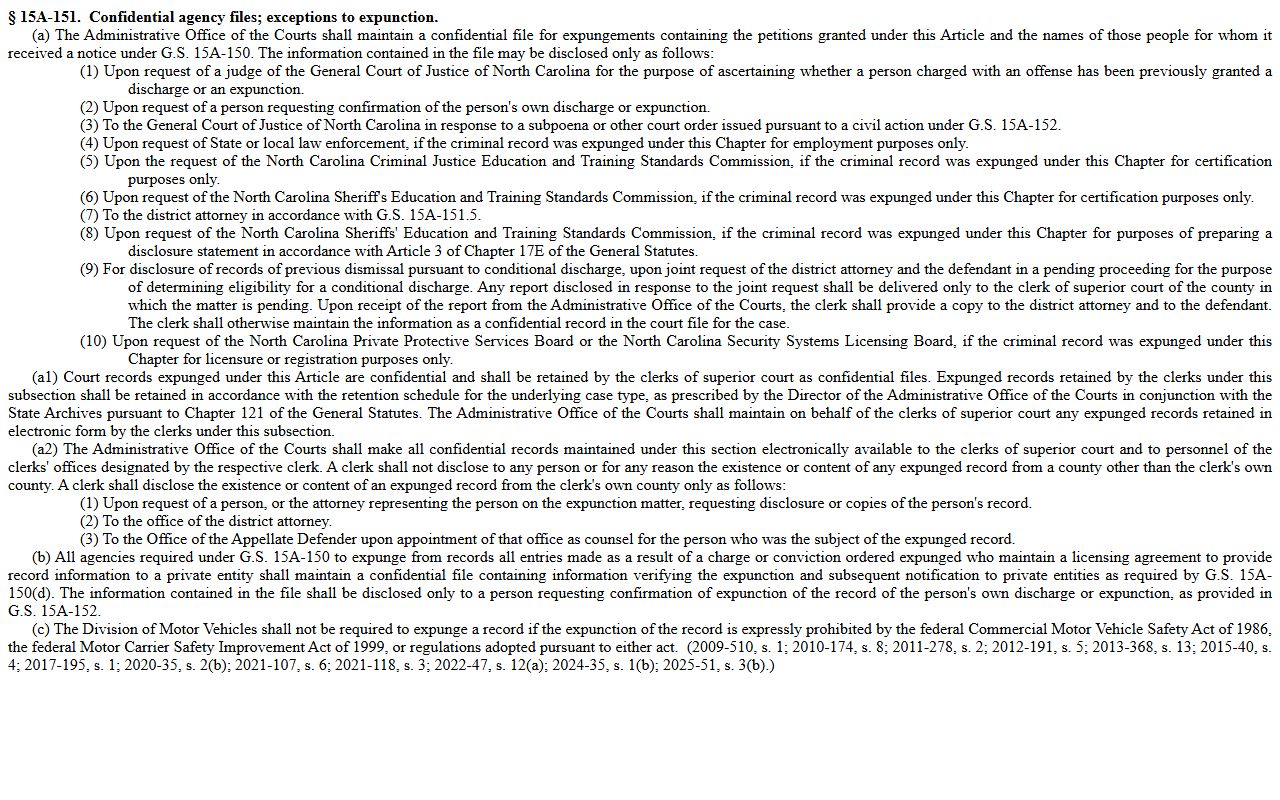
When an expunction is granted, ordinary public criminal court records searches should not be used to infer hidden confidential file contents.
The legal effect of expunction source below explains why a cleared public record is treated differently after relief is granted.
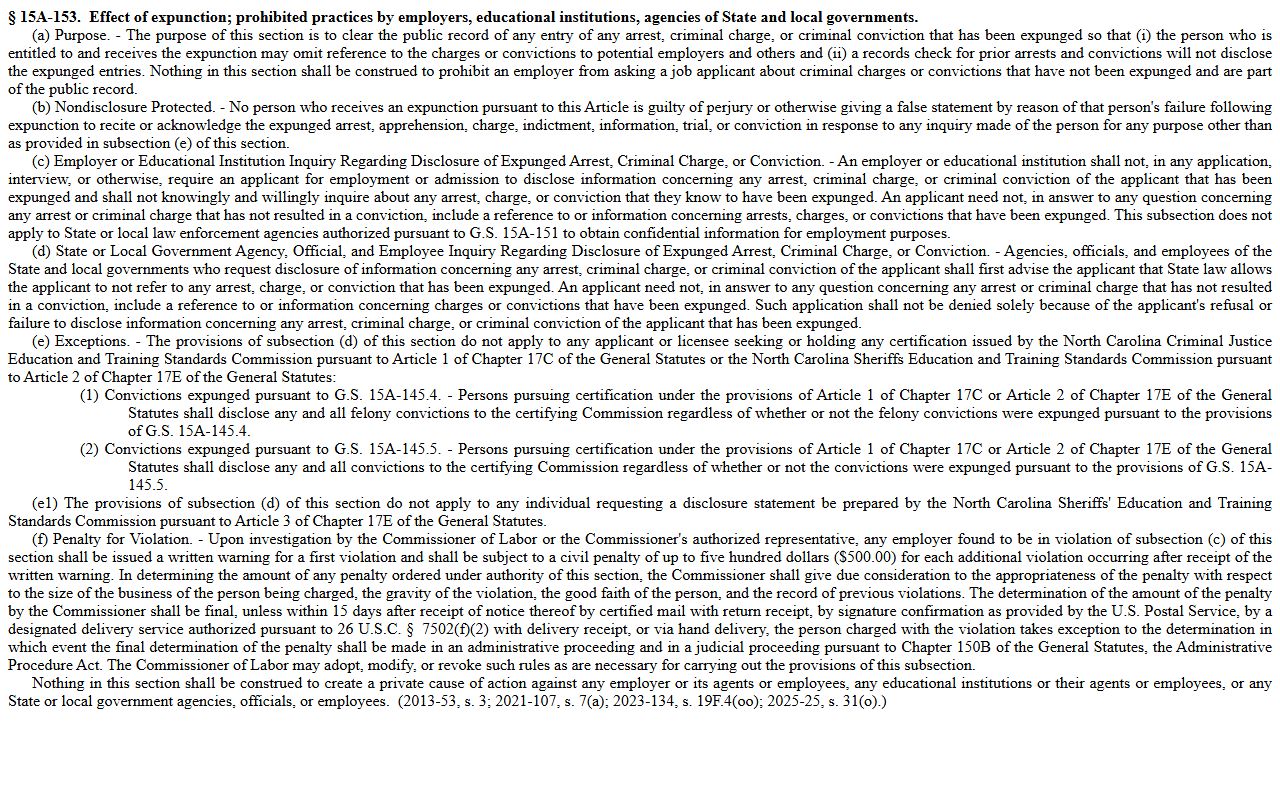
That effect is why sealed and expunged Martin County criminal records should be discussed separately from public convictions and pending charges.
Restricted Martin County Criminal Records
Juvenile delinquency and undisciplined records are restricted under North Carolina law and are not open like adult criminal case files. Juvenile abuse, neglect, and dependency records are also confidential. Victims do not automatically receive the full juvenile record. Mental health proceedings, sealed records, adoption matters, expunged files, and protected identifiers can also be withheld. Criminal history checks for employment, tenancy, credit, insurance, or other regulated purposes should not be built from a casual public search.
Important: Public criminal case lookup is not a substitute for an official background check or certified court record.
Martin County Clerk of Superior Court
305 E Main St
Williamston, NC 27892
(252) 809-5100
Monday-Friday, 8:00 AM-5:00 PM